Faith

50 Shades of Love (the Sequel)

Blog_BlurredHeartsI’ve decided I’d rather be known for what I stand for than what I stand against. And what I want to stand for is love. As Martin Luther King Jr. once said, “I’ve decided to stick with love. Hate is too great a burden to bear.” In a culture of hate, the temptation is to harden our hearts, but love is the only thing that can overcome evil.

We live in an age of tolerance, yet there remains much we should not tolerate—including abuse, racism, violence, and modern slavery. And yes, it is important to take a stand against such evils. Yet often in the process of fighting injustice, we fall prey to hateful, bitter hearts. We forget to confront the root issues—those things lacking in our culture and left in the void that contribute to the mindset behind injustice. And what is most lacking in our world? Love.

Our culture has developed a craving for abusive relational habits, such as those trending in modern media. And why? Because we’ve lost sight of the true definition of love, or we never knew what love was to begin with.

In a child development class I once took, we were told that instead of telling a child not to do something harmful or dangerous, we need to give them something productive to do instead. In a similar manner, we can warn others against engaging in media that promotes abusive relationships, but unless we find a positive alternative on which to focus our attentions, appetites will never change.

As a boat with no anchor is sure to drift, a life with no understanding of selfless, sacrificial love will drift toward abuse, racism, violence, slavery, and other destructive tendencies. If those who know of true love stand on the sidelines yelling, “Stop drifting. Stop drifting!” what good is it? What we need is the anchor.

There’s a game called “name the lie, insert the truth.” In the case of relationships, it is no game. The lie is that we exist to gratify our own selfish desires, or to enslave ourselves to the indulgent appetites of another. The truth is, we were specially designed for relationship based on supernatural, self-sacrificing love that builds one another up rather than tearing down.

I hate abuse, racism, violence, slavery, and similar evils because they dehumanize, demoralize, and degrade those made for a greater love and a higher purpose. But more than that, I want to stand for love—it’s power to heal, transform, and overcome. Over the next fifty days, I’m devoting my attentions to exploring what true love is—whether through a Bible verse, a quote, or an example of self-sacrificing love. My personal Facebook and Twitter campaign is #50ShadesOfTrueLove. Feel free to join me, if you want.

“Then you will know the truth, and the truth will set you free.” (John 8:32)

50 Shades of Love

AJ_LoveNeverFailsIn an age where humankind has explored the reaches of space and navigated the depths of the seas, it’s surprising to think we’re still struggling to understand what love is. Our search for its meaning has led to the murky gray waters of confusion, and the generations that follow are left to drown in the flood of misperceptions we’ve left behind. When we pursue love through self-gratification, we’re left empty and abused—because to live according to a selfish definition of love inevitably leads to suffering.

There’s a gaping hole in our hearts, crying out for love and fulfillment. Too often, we search for this love via means incapable of satisfying our deepest and truest needs. Current trends suggest intimacy can be found in sadistic relationships based on bondage, dominance, and slavery. The lie persists that there can be a fairytale ending to such relationships, when headlines and statistics so clearly prove otherwise. Too often, the actual result is suffering and death.

It’s grievous to consider the outcome of our distorted perceptions of love. Our own children are sold into slavery in countless numbers while we turn a blind eye, so consumed in our pursuit of self-gratification. Our high courts are inundated with cases of those fighting to do as they please while our own youth are trapped in bondage to modern slavery with no one to plead their cause. Have we become so desensitized that we care nothing for the innocent of our world while we go on chasing desperately after our own selfish desires?

True love involves self-sacrifice, not self-gratification. It’s when we lay down our lives for the love of another that we find life that is truly life, and love that is truly love. After all these years of fruitless searching, the most complete definition of love is found in ancient words: “Love is patient, love is kind. It does not envy, it does not boast, it is not proud. It does not dishonor others, it is not self-seeking, it is not easily angered, it keeps no record of wrongs. Love does not delight in evil but rejoices with the truth. It always protects, always trusts, always hopes, always perseveres. Love never fails.” (1 Cor 13:4-8)

The many shades of love include patience, kindness, faithfulness, goodness, gentleness, and sacrifice. Love consists of infinite shades of selfless virtue, and gray is not one of them. We don’t need more gray in our lives. We need more love. True love will never enslave us. It will set us free.

“There is no greater love than to lay down one’s life for one’s friends.” (John 15:13)

Waiting for Spring

Blog_WinterSpringThe following are words I wrote to a friend who was going through a difficult season where it seemed all signs of life had disappeared. I hope they encourage you, as well—whatever season you’re in…

I’ve been praying for words to encourage you in this challenging season you’re in. Just remember that during the winter, it seems like nothing’s happening. Everything looks dead and barren, cold and empty. But beneath the surface, there’s a lot taking place.The snow is pushing the dead leaves into the ground so they can be used to produce fertile soil. This fertile soil will produce all the beautiful flowers and leaves and green grass for the spring.

We never know exactly when spring is going to come. The groundhog doesn’t determine it, God does! And it always comes, even if it’s late or unexpectedly early. But it always comes after winter. Our temptation is to give up in the winter—to become cold and die right along with it. But if we give up too soon, we’ll miss the spring that’s right around the corner.

Hebrews 6 says to imitate those who through faith and patience inherit the promises. A lot of times we have faith to believe, but we need the patience to wait. I experienced so many set-backs and disappointments while waiting to adopt our children. It was a discouraging process, and it seemed the dream would never come to pass. I almost gave up! But now I am holding God’s promises in my arms.

In order for there to be resurrection (spring), there needs to be death (winter). You may feel like your dreams are dead now, but that only means there’s a resurrection coming! All the great men and women of God throughout history had to go through a season of waiting before the dream HE had for them was fulfilled.

Even John the Baptist began to doubt when he was imprisoned, but Jesus told him “blessed is the man who does not stumble on account of me.” In other words, don’t stumble over your own expectations of what God will do and when He will do it. He will always be faithful, even if He doesn’t work as we expect and in the timing we expect.

(Originally posted by Jen on the Tears of Joy Blog as “Encouragement for the Wait”)

One Small Voice

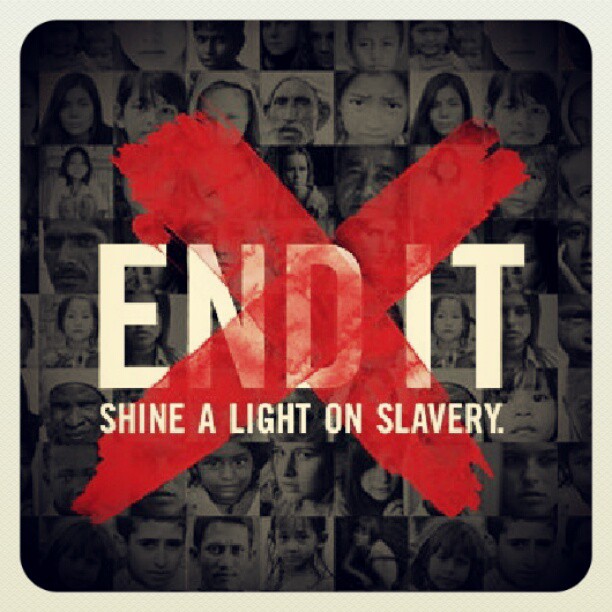
AJ_EndItI first heard about human trafficking when I was in college. An article I read detailed the horrors of children in Asia, harbored as slaves, kept in the same cages we use to transport our pets. The thought that something so appalling could happen in our world kept me awake at night, stole my appetite. Rendered me powerless.

But for me, it was just that. A thought. An article I read. Nothing compared to the reality that is slavery for 20 to 30 million people every day.

The fact that we even have a number for it staggers me. How can we have a statistic for the insurmountable injustice and not have done anything about the people behind those numbers? How do we even acquire these statistics? Go to the slave yards and houses, get the numbers, and leave the victims to suffer?

And what can average me do about it? Cry? Feel a tinge of regret that it’s happening then go on with my comfortable life?

Since reading that article, I’ve been overseas. Encountered street children in the Philippines. Spoken with victims of sex trafficking in the red light district of Holland. Seen children lined up “for sale” in Tijuana. And I’ve been here, in our own “back yard.” Driving home at midnight, stopping because there’s a girl on the corner who looks like she could be my niece. And she doesn’t want help because she fears for her life at the hands of her traffickers.

It happens here, you know. In the city and the suburbs.

And it makes me sick. Drives me to depression sometimes just thinking that slavery has never really been abolished, like they say. But that’s not enough! Feeling sick and depressed about something so awful is not gonna do anything.

So I told my sister I want to raise awareness, want to do something. I’m writing a book, starting a blog. But what can my one, little, average voice do? Especially when there’s so many voices out there, clamoring for attention. And my sister reminded me…we need all the voices we can get. No matter how small, no matter how average—every voice that rises in outcry against the injustice of modern slavery is one more voice in the battle for freedom.

“Speak up for those who cannot speak for themselves, for the rights of all who are destitute. Speak up and judge fairly; defend the rights of the poor and needy.” (Proverbs 31:8-9)

When the Lights go Out

Blog_CandlesI spent the night in the neonatal intensive-care unit once with my son. It was enough to know I’d never want to be there during a power outage. My cousin in-law, a director of the NICU at a local hospital, woke up early one January morning to that very crisis. Severe winter weather resulted in a power outage, and the back-up generator lost connection with the fuel supply.

She was responsible to oversee the safe transport of several critical-condition babies by teams of professionals through darkened hallways and stairwells. With only flashlights to guide them, the teams effectively intervened. Once power was restored, the babies were safely, miraculously returned to the hospital unharmed.

When she shared the story with me, I was amazed how she could have remained so clear-minded in the midst of such chaos. She said when she arrived at the hospital, she stood in the pitch-dark stairwell of her unit thinking of all the lives that were at stake. And she prayed.

Her story reminds me of how Captain Rostron of the Carpathia responded upon hearing the distress signal from the sinking Titanic. Before taking action, shipmates observed him praying. Once they moved forward, they were able to successfully navigate the same sea of icebergs that destroyed the Titanic.

Prayer may seem to some an afterthought or a crutch. But for the person of faith, prayer is the very lifeboat that draws us to the presence of a limitless God. For my cousin as for Captain Rostron, God responded to their prayers by bringing peace and clarity of mind to navigate through an otherwise catastrophic situation.

When the lights go out in our lives, there is one who supplies greater power. He may not make the difficulties go away. He may not make them easier. But He will give us the wisdom we need to make our way, and even lead others, safely through the darkness. He will give peace that passes all understanding, when there is no other source for such peace to flow.

Do not be anxious about anything, but in every situation, by prayer and petition, with thanksgiving, present your requests to God. And the peace of God, which transcends all understanding, will guard your hearts and your minds in Christ Jesus.” (Philippians 4:6-7)

Never Alone

Blog_Christmas_SadHow can we celebrate a season built around relationships and family when we feel alone?  We could be surrounded by people, but still feel like a barren tree in the middle of an empty forest.  The snow is falling all around, and the tree is frozen from the deepest root to the highest branch.  But no one seems to notice.

Just as that tree lost all its leaves in the midst of autumn, we might feel we’ve lost everything and won’t make it through the winter season of bitter coldness and death.  The Bible speaks of a woman who had lost everything in life.  Her name was Anna.  She was widowed only seven years into her marriage, and there is no mention of her having had children.  She stayed in the temple, fasting and praying.  And waiting.

Maybe she watched the people who came to the temple—seeing families with children, and wondering why she suffered such loss in her own life.  In her day, society looked down upon widows and often presumed that some sin led to their desolate condition.  But God saw Anna’s heart, and chose her to be among the first to embrace the child who would one day die to bring salvation to the world.

What was she thinking when she saw the baby?  The Bible doesn’t say except that she “gave thanks to God and spoke of the child to all who were looking forward to the redemption of Jerusalem.”  To redeem is to take something that is bad and turn it into something that is good.  It’s when God takes the ashes of our lives and turns them into something beautiful; when God uses the death of autumn and the silence of winter to bring about the life of spring.   Anna knew that God was going to take her difficult circumstances and turn them into something good.  And He did.

Just like He did for all those who had gone before her—those who were part of the lineage of the Savior.  Among them were widows who, like herself, had lost everything: Tamar, Ruth and Bathsheba.  Each story in the history of our Savior involves loss, but also reveals how God is able to take the trials of our lives and turn them into testimonies. And each story reminds us that even when we’ve lost everything, we’re never alone.

In the midst of war and battle, drought and famine, slavery and loss, our Savior came.  Our Savior is also called “Immanuel.”  It means “God is with us.”  And He is.

(Originally posted by Jen on the Tears of Joy Blog)

When Your Pain Becomes Fuel for your Fire

Blog_FireHave you ever been through something so painful it was hard to believe anything good could come of it? It felt like the fury of hell was unleashed against you—the forces of evil at war with your soul. Everywhere you turned, you faced a weapon built to destroy your faith.

God’s Word speaks of a time when His people will take the weapons once used against them and use them for fuel: “Then those who live in the towns of Israel will go out and use the weapons for fuel and burn them up—the small and large shields, the bows and arrows, the war clubs and spears. For seven years they will use them for fuel. They will not need to gather wood from the fields or cut it from the forests, because they will use the weapons for fuel” (Ezekiel 39:9-10).

There is no trial so great that God can’t turn it around and use it for good. When seasons turn, you will see the greater purpose for all that you’ve lost. God will enable you, by His grace, to use every weapon once used against you as fuel for your fire.

I’ve heard stories of those who’ve gone through unimaginably dark circumstances, yet their trials birthed in them a passion for something beyond themselves. They chose to take their impossibly difficult circumstance and use it to bring hope and healing. In the midst of their ashes, they found strength and beauty.

Though she had endured the loss of hearing and sight, Helen Keller was able to say, “Although the world is full of suffering, it is also full of the overcoming of it.” Though she could not see, she had vision for how her lifelong struggle would be used to bring hope and change to her generation and beyond.

My prayer is that you will find the purpose for your pain. May the Lord open your eyes to see the good that can come from your trial, and enable you to bring hope and healing from the ashes of your suffering. For every weapon forged to destroy your faith, may your faith increase—and may those weapons become fuel that sustains you and brings light to others walking through the dark seasons of life.

(Originally posted by Jen on “Tears of Joy” Blog)