Religion

Slow Down and Listen

Blog_SittingByOcean

God, slow us down. Help us to listen to your still small voice, to hear what you are saying above the clamor of this world. Show yourself for who you truly are, not for what we’ve tried to make you to be. And as we rightly hear you, bring healing to our relationships with you and with others, as only you can.


Source: Misunderhearing

Photo Credit: Sunrise, People – Free images on Pixabay

Learning to Listen

Blog_Soundwaves

The other day, one of my four-year old students decided to step in and help mediate a conflict in which one kid accused another of name-calling. “That’s not what happened!” she said. “They just misunderheard each other.” Her vocabulary may not have been accurate, but I realize how right she is.

How many misunderstandings are really a result of “misunderhearing”? We half-listen, not hearing what the other person is trying to say because we’re already formulating what we want to say in response. Or we misinterpret what was said altogether, sifting their words through our own preconceived notions.

My old landlord always used to say, “the root of all conflict is uncommunicated and unmet expectations.” How much relational conflict would be avoided if we took to heart the Bible verse exhorting us to be “quick to listen, slow to speak, and slow to become angry?” If we just slowed down enough to hear and to respond appropriately, what needless pain would we avoid?

This applies within our human relationships, and also in our relationship with God. How many times do we misunderhear his word? We take a verse out of context, twist it as we desire then wonder why it’s not working like some magic spell over our lives. Bitterness sets in as we mistakenly believe God didn’t make good on his promise, when all along we weren’t rightly hearing what he had to say.

And how extreme has our world’s caricaturized vision of God become as it listens to lies and half-truths perpetuated by media propaganda and hypocritical churchgoers, never bothering to search his word for the truth of who he is. If only we would listen. If only we would hear. How much more would we know God for who he truly is, and not what our idolatrous hands have made him to be?

“All this is from God, who through Christ reconciled us to himself and gave us the ministry of reconciliation; that is, in Christ God was reconciling the world to himself, not counting their trespasses against them, and entrusting to us the message of reconciliation. Therefore, we are ambassadors for Christ, God making his appeal through us. We implore you on behalf of Christ, be reconciled to God.” (2 Corinthians 5:18-10)

God, slow us down. Help us to listen to your still small voice, to hear what you are saying above the clamor of this world. Show yourself for who you truly are, not for what we’ve tried to make you to be. And as we rightly hear you, bring healing to our relationships with you and with others, as only you can. In Jesus’ name.

Photo Credit: Sound Waves Free Stock Photo – Public Domain Pictures

Written in Sand

Blog_LoveWrittenInSandThere’s been a lot of verbal stone-throwing in our world lately. Those who disagree with the beliefs or lifestyles of another group don’t hesitate to speak harsh, condemning words, and those with opposing viewpoints are quick to return the favor. Truth and love are lost in the war of words, leaving the world with a skewed perspective of God—some thinking him a hateful tyrant, others believing him a lenient father who smiles and winks when those he so loves do as they please.

In Jesus’ day, an adulterous woman was caught in the line of fire, an angry mob surrounding her, stones in hand, prepared to hasten her death. When Jesus showed up, the mob hoped to trap him in their extremes. Would he grab a stone and hurl it? Or would he embrace the woman’s lifestyle that likely tore families, and her own life, apart?

Jesus catered to no one. Instead, he knelt in the sand and started writing. When the crowds questioned him, he stood, saying, “If any one of you is without sin, let him be the first to throw a stone at her.” Then he knelt again, writing, as one by one the accusers dropped their stones and left the scene.

What was he writing that so pierced the hearts of the crowd? Many speculate he’d outlined the Ten Commandments, a visual reminder of how far all had fallen equally short. In the end, he stood, telling the woman: “Has no one condemned you? Then neither do I condemn you.”

Most of us would like to close the story there, defining love by the lack of condemnation. But Jesus went a step further, saying, “Go now and leave your life of sin.” He did not condemn the sinner, but he did confront the sin in all its destructive capacities. True, it’s unloving to condemn. Yet it’s also unloving to turn a blind eye when someone’s life choices lead them on a pathway of certain death.

Jesus understood something about the woman, and the crowds so quick to condemn. We’re all yearning: longing for something we don’t have…seeking to fill a hole in our hearts…knowing there has got to be something better. In the midst of our search, we’ve all fallen far short of that which will truly fulfill. To condemn others for seeking to fill their void is to condemn ourselves, for haven’t we all turned to broken cisterns that hold no water? Yet for those who’ve found God alone can fill that void, how very unloving to tell another “go now, do whatever pleases you,” all the while knowing our greatest pleasure comes when our identity is found in our loving Creator.

Note that whatever Jesus wrote, he wrote in the sand. Our self-made identities are not written in stone. We are not defined by our habits. All we’ve done, seeming so worthy of condemnation, is written in sand, washed away by the love of God the moment we choose to turn from the lie that tells us freedom is doing whatever we please to the truth that freedom is found in a life lived for the one who created us with greater things in mind.

“Thou hast made us for thyself, O Lord, and our hearts are restless until they find their rest in thee.” (St Augustine)


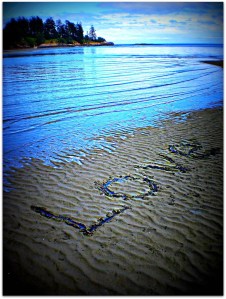
Photo Credit: Love Written in the Sand | Flickr by All Things Sprite and Beautiful

True Faith

Blog_DriftwoodFlowers

True faith believes God has our best interests in mind, whether or not his answers align with our desires.


Source: The Most Difficult Prayer

Photo Credit: Driftwood – Free photos on Pixabay

The Hope I Cling To

Blog_CloudySkies

In the end, it’s true, “In this world, we will have trouble.” But Jesus also said, “take heart! I have overcome the world.” That’s the hope I cling to.


Source: When Storms Roll In

Photo Credit: Cloudy Sky Across The Horizon | Flickr – Photo Sharing!

When Storms Roll In

Blog_ImpendingStormIt was one of THOSE days today. The kind where darkness threatens to descend and overtake any hint of joy. Where I’m tempted to let the blanket of discouragement douse out the flicker of hope.

I’ve been writing a lot about trials lately, but quite honestly it seems I’ve been in the clear for a few months. After a long rollercoaster season of ups and downs, I’ve come to the point where I can see clearly enough to write encouragement from a higher perspective. It’s not that it’s been an easy year, in particular, just a less afflicted year.

Then came some discouraging news, a new wave of challenges brewing on the horizon. I guess I’m not off the hook, after all. Didn’t Jesus say, “in this world, we will have trials”? Yet when they come, we’re tempted to throw those OTHER promises in his face—the lighter, easier ones that don’t deal with suffering. “Why have you forsaken me?” we cry, forgetting it’s not him who’s forsaken us.

Maybe, in the end, it’s us who’ve forsaken his word, looking to it only for the promises of ease and comfort. We accuse God of giving us a stone when we asked for bread, not remembering the word that declares God a loving father who gives his children what they need. It’s a matter of how we see each gift he gives.

When his precious daughter Rachel was killed in the 1999 Columbine massacre, Darrel Scott talked about developing “see through” vision. When it seemed he’d been handed a stone, he was determined to see through his awful tragedy to the good that could come from it. He devoted his life, and his daughter’s memory, to bring blessing in the midst of evil.

I can’t say I’ve yet encountered anything near as tragic as Darrel Scott and his family, but I can say his sentiments about “see through” vision have kept me over the years through the various trials I’ve encountered. I’m learning to take what’s given me and see that God can take even the most hopeless of circumstances and bring forth life.

In the end, it’s true, “In this world, we will have trouble.” But Jesus also said, “take heart! I have overcome the world.” That’s the hope I cling to.

“Shall we accept good from God, and not trouble?” (Job 2:10)


Photo Credit: Rainy Skies on the Horizon | Flickr – Photo Sharing!

Embracing Change

Beyond_InItsTime

If we can look beyond the moment of change to the ultimate outcome, we may more readily embrace it. Faith enables us to see change as a seed, piercing the ground and transforming the soil. Our response is to patiently wait, knowing the seed will transform into something beautiful in its time.

Source: Embracing Change