
Source: the Get Up Call
Photo Credit: the bed | by porsche-linn | Flickr

There is a truth that is greater than the lie. Our identity is not found in what we’ve done, for the good or for the bad. Our identity is not about who we’ve been but whose we are. Jesus Christ died on the cross that our identities can be transformed. In him, we are given a new identity. We’re no longer the addict, the prisoner, the failure. Instead, we’re chosen, redeemed, forgiven, loved…and free.
Source: A Case of Stolen Identity
Photo Credit: File:Flower reflection.jpg – Wikimedia Commons
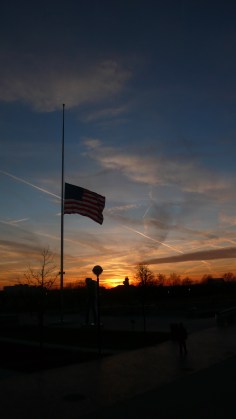 It seems the flags have been flying half-mast more often than not these days. Sometimes we drive by, and we know. “Oh, it’s for that tragedy in such-and-such a city,” or, “It’s for the terror attack in that other town.” Other times, we don’t. “What now?” we ask.
I heard on the radio that our president has called for flags to be at half-mast on sixty-seven occasions since he took office. And how many more times will that call go forth as we tread through the coming years in our sin-plagued land?
Half-mast “refers to a flag flying beneath its summit on a pole” as a symbol of “respect, mourning, or distress.” Do we realize the degree of distress our country is in when we so consistently see flags flying half-mast? Or do we walk on, somber for a moment, soon forgetting the distress call? Has it become so commonplace that we fail to remember the symbolism?
As the flags fly beneath their summit, maybe our hearts need to be half-mast as well. Respecting, mourning, remembering. Understanding of the times.
What tragedy will it take to bring us to our knees? When will we humble ourselves and turn from our selfish ways? When will we turn to the one who created us for so much more than what we’ve settled for? When will we admit that we need help? When will we pray?
And when will we stop going on, life as usual, when we all know…it’s NOT?
Every time we see flags at half-mast, it serves as a wake-up call. We are not invincible. We are not all-sufficient. We need a savior.
Photo Credit: Half-mast – Wikipedia, the free encyclopedia
 The sign said, “do not throw stones.” Nothing ambiguous about it. But at different times throughout the day, as we walked along the beach, the common scene was that of people throwing rocks…at the sign.
What is it about the law that makes us want to do the opposite? What is it about rules that arouse disobedience? And what weakness within motivates rebellion? The law cannot change a man any more than the mirror that exposes a dirty face can make it clean.
When they were teens, my husband and his brother decided to play a joke on their friend. While he was sleeping, they decorated his face with marker then woke him when they arrived at the local burger joint. What do you think the guy did when he saw his face in the bathroom mirror? Screamed, yes. But did he then take the mirror off the wall to wash his face? No. The mirror pointed him to the only thing that could make him clean…water.
Lasting change can only come through our recognition of the powerlessness of the law to change us. The law, like the curb on a street, can keep us safe. And like a target, it shows us where to place our aim. But like a mirror, it shows us how far we fall short…and how much we need divine intervention if we’re ever to change. Only God’s supernatural power can enable us to change. Only His love can so radically transform us that our lives are never the same. And only then, out of gratitude, can we live the lives we were destined to live.
“For the law of the Spirit of life has set you free in Christ Jesus from the law of sin and death. For God has done what the law, weakened by the flesh, could not do…” (Romans 8:2-3)

All we’ve done, seeming so worthy of condemnation, is written in sand, washed away by the love of God the moment we choose to turn from the lie that tells us freedom is doing whatever we please to the truth that freedom is found in a life lived for the one who created us with greater things in mind.
Photo Credit: Footprints in the Sand | Flickr – Photo Sharing!
 There’s been a lot of verbal stone-throwing in our world lately. Those who disagree with the beliefs or lifestyles of another group don’t hesitate to speak harsh, condemning words, and those with opposing viewpoints are quick to return the favor. Truth and love are lost in the war of words, leaving the world with a skewed perspective of God—some thinking him a hateful tyrant, others believing him a lenient father who smiles and winks when those he so loves do as they please.
In Jesus’ day, an adulterous woman was caught in the line of fire, an angry mob surrounding her, stones in hand, prepared to hasten her death. When Jesus showed up, the mob hoped to trap him in their extremes. Would he grab a stone and hurl it? Or would he embrace the woman’s lifestyle that likely tore families, and her own life, apart?
Jesus catered to no one. Instead, he knelt in the sand and started writing. When the crowds questioned him, he stood, saying, “If any one of you is without sin, let him be the first to throw a stone at her.” Then he knelt again, writing, as one by one the accusers dropped their stones and left the scene.
What was he writing that so pierced the hearts of the crowd? Many speculate he’d outlined the Ten Commandments, a visual reminder of how far all had fallen equally short. In the end, he stood, telling the woman: “Has no one condemned you? Then neither do I condemn you.”
Most of us would like to close the story there, defining love by the lack of condemnation. But Jesus went a step further, saying, “Go now and leave your life of sin.” He did not condemn the sinner, but he did confront the sin in all its destructive capacities. True, it’s unloving to condemn. Yet it’s also unloving to turn a blind eye when someone’s life choices lead them on a pathway of certain death.
Jesus understood something about the woman, and the crowds so quick to condemn. We’re all yearning: longing for something we don’t have…seeking to fill a hole in our hearts…knowing there has got to be something better. In the midst of our search, we’ve all fallen far short of that which will truly fulfill. To condemn others for seeking to fill their void is to condemn ourselves, for haven’t we all turned to broken cisterns that hold no water? Yet for those who’ve found God alone can fill that void, how very unloving to tell another “go now, do whatever pleases you,” all the while knowing our greatest pleasure comes when our identity is found in our loving Creator.
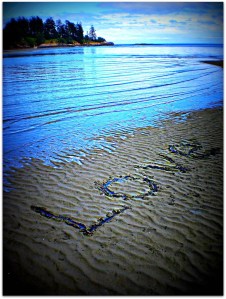
Note that whatever Jesus wrote, he wrote in the sand. Our self-made identities are not written in stone. We are not defined by our habits. All we’ve done, seeming so worthy of condemnation, is written in sand, washed away by the love of God the moment we choose to turn from the lie that tells us freedom is doing whatever we please to the truth that freedom is found in a life lived for the one who created us with greater things in mind.
Photo Credit: Love Written in the Sand | Flickr by All Things Sprite and Beautiful

 This Life & Beyond
You must be logged in to post a comment.